
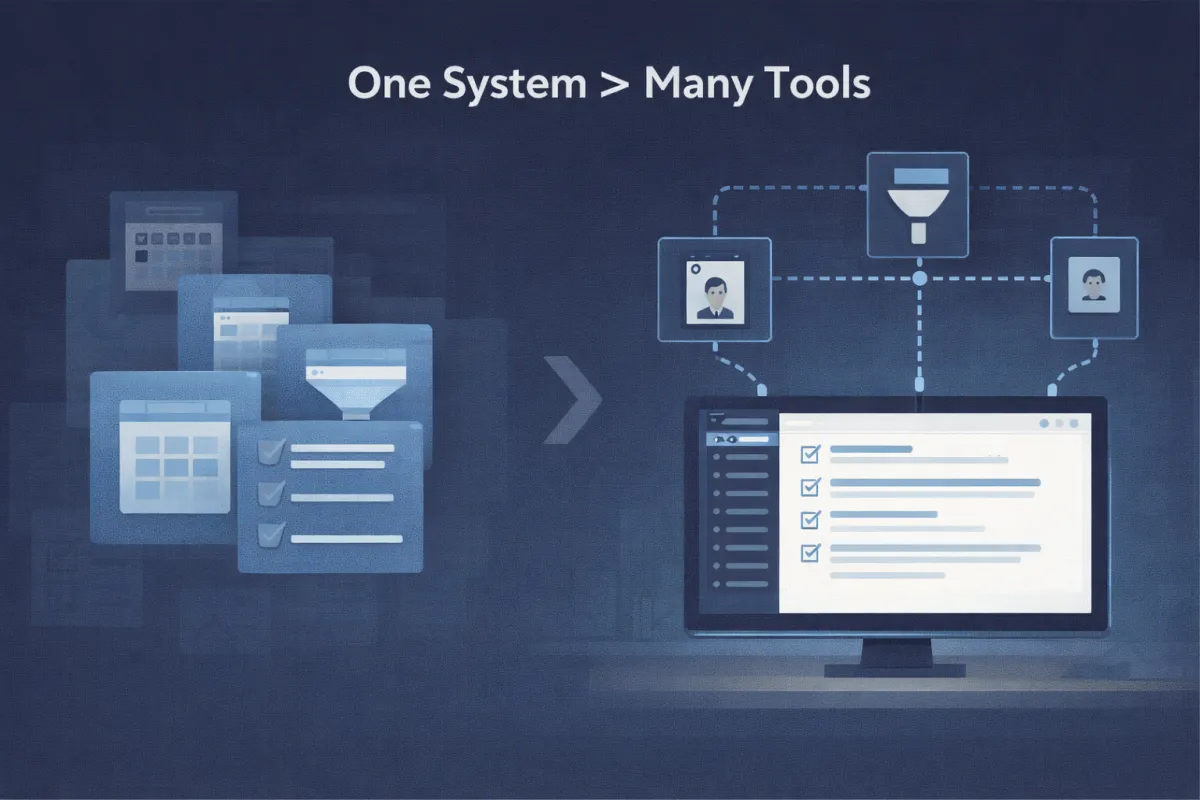
Why Advisors Need a Single System — Not More Tools
Introduction: The Tool Overload Problem
Most tax professionals and financial advisors don’t suffer from a lack of software.
They suffer from too much software.
CRMs. Email platforms. Calendars. Forms. Funnels. Scheduling tools. Automation tools. Reporting dashboards. Compliance tools.
Each tool solves one problem — but together, they create a bigger one: fragmentation.
When systems don’t talk to each other, advisors end up doing the work manually in between. That’s where time, energy, and consistency get lost.
More Tools ≠ More Leverage
The common assumption is:
“If I just add one more tool, things will finally run smoothly.”
In reality, the opposite usually happens.
Each new tool introduces:
Another login
Another workflow
Another integration to manage
Another failure point
Instead of leverage, advisors get maintenance.
Growth slows not because advisors aren’t capable — but because the system is working against them.
The Real Cost of Fragmentation
Disconnected systems create invisible friction across the practice:
Leads fall through the cracks
Follow-ups happen inconsistently
Messaging feels disjointed
Data lives in multiple places
Clients experience delays or confusion
Over time, this leads to:
Missed opportunities
Burnout
A ceiling on growth
Not because advisors lack effort — but because effort isn’t being multiplied.
Why Systems Beat Tools Every Time
High-performing advisory practices don’t think in terms of tools.
They think in terms of systems.
A system:
Has a clear purpose
Connects every step of the client journey
Reduces decision-making
Runs consistently in the background
When everything is part of one unified flow, advisors regain control — and time.
What a Unified System Looks Like
A modern advisory system brings everything together:
One source of truth for client data
One consistent follow-up engine
One scheduling and intake flow
One messaging framework
One place to manage growth
Instead of juggling platforms, advisors operate inside a single operating environment that supports how they actually work.
The Hidden Benefit: Clarity
When systems are unified, something unexpected happens.
Clarity improves.
Advisors know:
What happens next
Where leads are
How clients move through the process
What needs attention — and what doesn’t
This clarity reduces stress and creates confidence — both internally and for clients.
Why This Matters Now More Than Ever
Client expectations are rising.
Responsiveness matters. Consistency matters. Experience matters.
Practices that rely on disconnected tools struggle to keep up — not because they’re behind, but because their systems weren’t designed to scale.
Those who invest in integration instead of accumulation gain a real advantage.
Start With the System — Then Add Tools Intentionally
The goal isn’t to eliminate tools entirely.
It’s to:
Start with a unified foundation
Add tools only when they enhance the system
Ensure everything works together by design
That’s how sustainable growth actually happens.
Closing Thought
More tools won’t save a practice.
Better systems will.
When everything works together, advisors stop managing software — and start leading their practice again.