
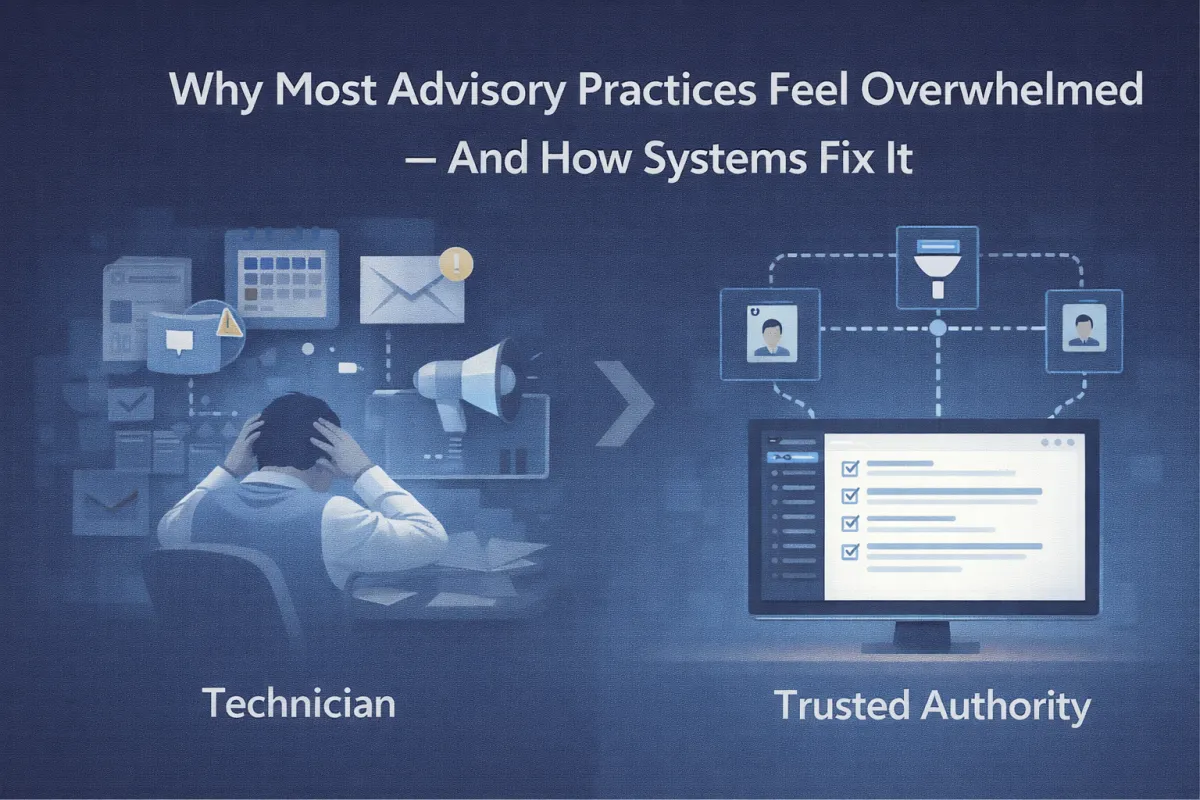
Why Most Advisory Practices Feel Overwhelmed — And How Systems Fix It
Introduction
Most tax professionals and financial advisors don’t struggle because they lack expertise.
They struggle because their practice runs on memory, manual effort, and scattered tools.
As client demands increase, regulations evolve, and expectations rise, many advisors find themselves working harder just to stay in the same place. The problem isn’t effort — it’s the absence of a cohesive system.
The Hidden Cost of a Non-Systemized Practice
When systems are missing or fragmented, the symptoms show up quickly:
Follow-ups happen inconsistently
Client communication lives across email, text, and notes
Leads slip through the cracks
Onboarding feels different every time
Advisors stay “busy” but not necessarily productive
Over time, this creates burnout — not because the work is hard, but because it’s unpredictable.
Why Tools Alone Don’t Solve the Problem
Many advisors try to solve this by adding more tools:
A CRM here
A scheduling tool there
Email software layered on top
But disconnected tools don’t create clarity. They often increase complexity.
What advisors actually need isn’t more tools — it’s intentional systems that define:
What happens
When it happens
Who it happens for
And how it happens every time
What “Systems Thinking” Looks Like in a Modern Practice
A systemized advisory practice isn’t rigid or impersonal. In fact, it’s the opposite.
When systems are in place:
Clients receive timely, consistent communication
Advisors know exactly what step comes next
Onboarding becomes smoother and faster
Follow-ups happen automatically without chasing
Time is freed up for higher-value conversations
Systems don’t replace relationships — they protect them.
The Difference Between Busy and Scalable
There’s a key distinction successful advisors make:
Busy practices rely on people remembering things.
Scalable practices rely on systems handling them.
This shift allows advisors to:
Serve more clients without sacrificing quality
Reduce mental load
Focus on strategy instead of task management
Build a practice that supports time freedom, not constant availability
Why Systems Are the Foundation for Growth
Marketing, AI, automation, and authority all sit on top of systems.
Without a stable foundation:
Growth becomes chaotic
Automation breaks
Client experience feels inconsistent
With systems in place:
Growth feels controlled
Technology enhances the practice
Advisors regain confidence in their operations
Final Thought
Most advisors don’t need to work harder.
They need their practice to work for them.
Systems aren’t about complexity — they’re about clarity. And clarity is what allows a practice to grow without overwhelm.
Introduction
Most tax professionals and financial advisors don’t struggle because they lack expertise.
They struggle because their practice runs on memory, manual effort, and scattered tools.
As client demands increase, regulations evolve, and expectations rise, many advisors find themselves working harder just to stay in the same place. The problem isn’t effort — it’s the absence of a cohesive system.
The Hidden Cost of a Non-Systemized Practice
When systems are missing or fragmented, the symptoms show up quickly:
Follow-ups happen inconsistently
Client communication lives across email, text, and notes
Leads slip through the cracks
Onboarding feels different every time
Advisors stay “busy” but not necessarily productive
Over time, this creates burnout — not because the work is hard, but because it’s unpredictable.
Why Tools Alone Don’t Solve the Problem
Many advisors try to solve this by adding more tools:
A CRM here
A scheduling tool there
Email software layered on top
But disconnected tools don’t create clarity. They often increase complexity.
What advisors actually need isn’t more tools — it’s intentional systems that define:
What happens
When it happens
Who it happens for
And how it happens every time
What “Systems Thinking” Looks Like in a Modern Practice
A systemized advisory practice isn’t rigid or impersonal. In fact, it’s the opposite.
When systems are in place:
Clients receive timely, consistent communication
Advisors know exactly what step comes next
Onboarding becomes smoother and faster
Follow-ups happen automatically without chasing
Time is freed up for higher-value conversations
Systems don’t replace relationships — they protect them.
The Difference Between Busy and Scalable
There’s a key distinction successful advisors make:
Busy practices rely on people remembering things.
Scalable practices rely on systems handling them.
This shift allows advisors to:
Serve more clients without sacrificing quality
Reduce mental load
Focus on strategy instead of task management
Build a practice that supports time freedom, not constant availability
Why Systems Are the Foundation for Growth
Marketing, AI, automation, and authority all sit on top of systems.
Without a stable foundation:
Growth becomes chaotic
Automation breaks
Client experience feels inconsistent
With systems in place:
Growth feels controlled
Technology enhances the practice
Advisors regain confidence in their operations
Final Thought
Most advisors don’t need to work harder.
They need their practice to work for them.
Systems aren’t about complexity — they’re about clarity. And clarity is what allows a practice to grow without overwhelm.